
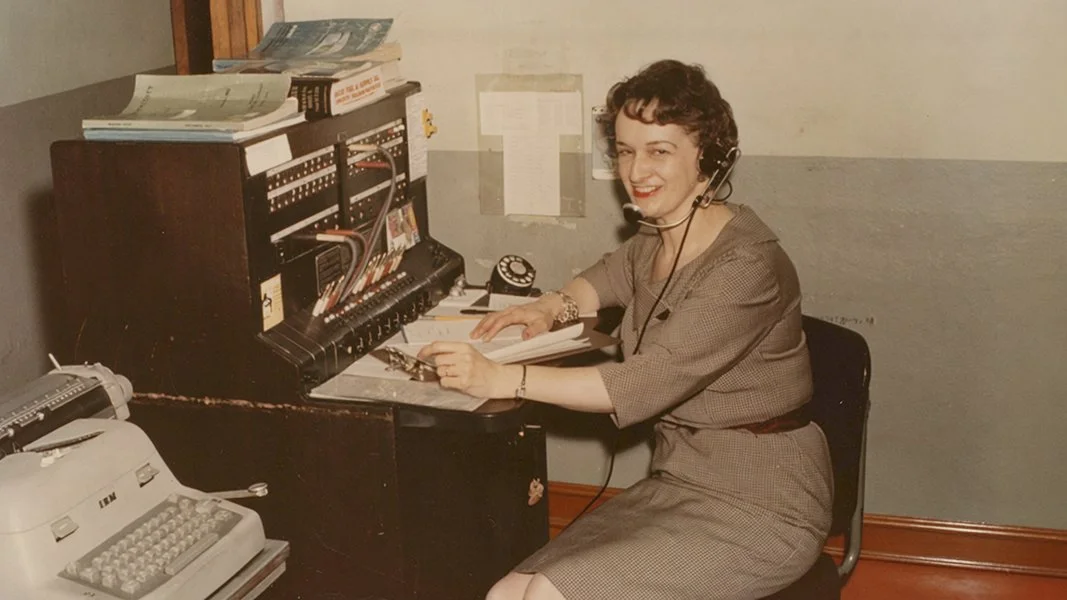
Fortunately I know a lot about the woman in this photo. But what if all I had to go on was the photo itself?
Unfortunately, many of us have old family photos showing people we know little about. No one is around to share memories of them, no letters or diaries survive, so there is little to go on. I’m happy to say that is not the case for me when it comes to this image.
But what if it were? Then what would I do?
Let’s pretend for a moment that the only thing I know nothing about the woman in this photograph other than what I see right here. How much can I conclude about her from this image alone ?
When was this photo taken?
With just a little online research into the evolution of telephone switchboards and models of IBM typewriters, I can tell that the picture was taken sometime between the late 1950s and early 1960s. (Yes, AI is a good tool—but remember not to take its responses at face value. Consult the sources it gives you. And if it doesn’t provide any—sometimes the case for Google’s AI mode—ask for them.)
Luckily, I can also just make out the enough information on the cover of that top book on the right to see that it’s a well-thumbed-over 1963 telephone directory. So a safe assumption would be to date the photo “c. 1963–64.”
Where was it taken?
It was obviously taken in an office of some sort, but in what state, city, or region was that office located? Looking at the first several letters on the telephone directory’s spine and the red stamp on the large book to its left—which reads “Niles Fuel & Supply Co.,” it’s a safe bet that it’s a Youngstown, Ohio, directory. Given the post-war northeastern Ohio setting, it’s safe to say that the office is likely in a manufacturing facility.
What else to the visual clues tell us?
The ring on her finger suggests that she’s married and her general appearance suggests she’s probably in her 40s.
Why did someone take this picture?
The picture may well have been taken for a company newsletter. But when you’re working with family photos, you may learn a lot simply by typing a description of the photo into a search engine. That’s because photos often follow certain conventions or trends that are particular to a time and place. In this case, I typed woman-at-desks-with-switchboards-c1960 and looked at the images that appeared on my screen.
I got a lot of results and they were clustered in archival collections owned by Getty and Alamy of women office workers in the 1950s and ’60s. The mere existence of these collections suggests that the woman was part of a phenomenon that a great many people thought it important to document.
The search results could include some good sources of information about these kinds of office photos. I took another avenue, choosing instead to focus on the broader subject of the history of women’s work in the decades following World War II. How common was it for women, particularly married women, to work outside the home? What were the typical demographic characteristics of married women performing office work in this era?
Given that so many of us are likely to have women in our families who were part of the American labor force in the decades during and after World War II, here are a few useful online sources. These are focused on the period before the women’s movement in the 1970s, often associated (too simplistically) with the moment women flocked to the workplace:
PBS’s American Experience article Tupperware! Women and Work After World War. Brief and very accessible piece focused on the women who chose to work, offering some social and cultural forces to consider.
New York Historical’s Women & the American Story’s article “What Happened to Rosie?” Includes excerpts from a government report on women workers after 1945, along with summaries.
“The history of women’s work and wages and how it has created success for us all,” an article by Janet Yellen, based on a speech she delivered during her tenure at Chair of the Federal Reserve. Summarizes most of the 20th century, from the 1930s into the 1990s.
In spite of the housewife stereotype, a greater percentage of American women, including married women, were working outside the home than ever before in the 1960s. While women of color were disproportionate among these women, they included plenty of white married women, too.
How does this woman’s story fit into that broader narrative?
Happily, I have some insight based on firsthand memories and stories. The woman is my grandmother, Jean McCally (1918–2004). The picture was taken at the American Welding Co., where she worked for many years. In Part II, I’ll share more about this strong-willed, generous, charismatic woman who loved the movie 9 to 5.